

1. Introduction: Your Path to a Rewarding PSW Career
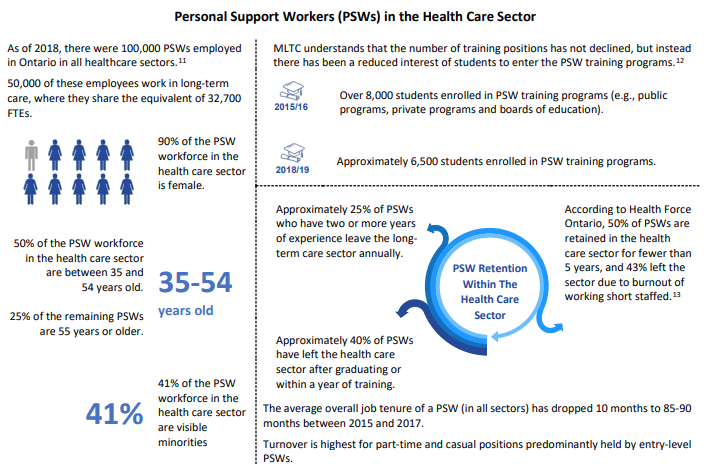
A Personal Support Worker (PSW) is a vital healthcare professional who provides essential, hands-on care and support to individuals who need assistance with their daily lives. This typically includes the elderly, people with disabilities, those recovering from illness or surgery, or those with chronic health issues.
PSWs are often considered the cornerstone of the Canadian healthcare system because they spend the most one-on-one time with patients/clients, whether in their private homes, long term care facilities, retirement homes, or hospitals.
 (Source: Ministry of Long-Term Care | Ontario.ca)
2. What PSWs Can Do and What PSWs Must do
PSWs Can: | PSWs Must: |
Personal support workers can assist people with things they do every day, like bathing or getting dressed. | Keep a constant eye on the person’s vitals and their safety in the environment. |
Carry out certain authorized duties given by a Regulated Health Professional (RHP), as long as they have been specifically trained for that task. | Ensure that all actions and communication match the official Plan of Care. |
Give assistance and reminders for taking prescribed medication. | Ensure all client records and documentation are completed and up-to-date. |
Handle simple cleaning and tidying duties. |
3. Top 5 PSW Code of Conduct
1. Respect Dignity and Individuality.
- Core Duty: Always treat patients/clients with compassion and respect their culture, identity, and personal beliefs.
- Key Action: Never impose your personal beliefs on patients, and consistently maintain their privacy and dignity.
2. Maintain Trust with Safe, Competent Care.
- Core Duty: As a PSW you must provide safe, high quality care, working only within your legal scope of practice.
- Key Action: Continuously improve your skills, seek advice when needed from authorised officials, and always maintain accurate documentation.
3. Continuous Observation and Reporting.
- Core Duty: You are responsible for ensuring patient safety by being aware of the client’s condition and environment.
- Key Action: Immediately report and document any changes in a patient’s condition or any unsafe conditions to your supervisor.
4. Act with Integrity to Maintain Trust.
- Core Duty: Uphold the professional relationship by protecting patient sensitive information and avoiding conflicts of interest.
- Key Action: Protect patient confidentiality, maintain strict professional boundaries, and never accept gifts or engage in personal relationships with clients.
5. Work Respectfully with Colleagues.
- Core Duty: Collaborate effectively and professionally with all members of the healthcare team to better optimize healthcare service.
- Key Action: Take strict action to stop any unsafe, unethical, or abusive practices, and support/educate other staff and students.
4. What Is a Retirement Home?
A Retirement Home is a private residence for older adults who want to live in a community setting while receiving some help with daily life. It’s meant for seniors who are still mostly independent but need more support than living alone offers. These homes provide various living spaces, often including meals, housekeeping, and social activities as part of a base fee. Unlike Long-Term Care, Retirement Homes are not primarily medical facilities; residents can choose to purchase extra care services, such as help with bathing or medication, on an as-needed basis. The focus is on providing a balanced lifestyle with community engagement and customizable support.
5. What Is a Respite Hotel?
A Respite Hotel is a special kind of short-term residence that provides temporary care for people who can’t be left unsupervised, especially those with complex needs like memory loss.
Its main purpose is to offer family caregivers a planned break (or “respite”) from their caregiving duties. While the family rests, their loved one receives professional, high-quality support in an environment that is both safe and engaging.
6. What is Home Care?
Home care involves PSWs providing care directly in client’s homes. This allows individuals to maintain their independence and comfort in a familiar environment, rather than moving into a facility.
7. What is Long Term Care?
According to Ontario Health at Home ¹ : Long-Term Care (LTC) is a service provided in residential homes for people whose health needs are too complex to manage at home. These specialized homes offer ongoing support, professional nursing, and personal care (like help with bathing and dressing). This type of care is typically needed due to old age, disability, or serious health issues, and it includes services like meals, medication administration, and specialized therapies.
8. Main differences between Retirement Homes, Long-Term Care, Home Care and Respite Hotel
Feature | Long-Term Care (LTC) Home | Home Care | Retirement Home | Respite Hotel (Specialized) |
Who it’s For | People with high, ongoing medical needs who need 24-hour support. | People who want to stay in their own house and need help with daily tasks. | People who are mostly independent but want community, services, and some support. | People (often with Memory Loss) needing temporary, high-level support for short stays. |
Medical Support | 24-hour nursing staff is onsite; doctors and specialists visit. | Nurses and specialists visit your home for short- and long-term conditions. | Very light support offered; advanced care often costs extra or is not available. | 24-hour nursing with highly trained staff specializing in memory loss care. |
Daily Tasks Help | Full assistance provided for hygiene, dressing, and eating. | Caregivers help with cooking, dressing, and hygiene in your home. | Services are usually a-la-carte (you pay extra for each type of help you need). | All-inclusive assistance with dressing, bathing, and medication management. |
Living Space | May require sharing a room until a single room is available. | You stay in your own customized home. | Offers various options, from private apartments to shared rooms. | Private, fully furnished rooms with built-in security features. |
Safety & Security | Highly regulated with security alarms and surveillance throughout the facility. | Your responsibility to install and manage all security systems. | Offers basic security features; residents can usually come and go freely. | Fully secured environment with safety features specifically designed for memory loss. |
Activities | Daily group activities (games, music, exercise) organized by the facility. | Caregivers participate in activities you enjoy, like card games or shopping trips. | Follows a monthly calendar; residents attend activities on their own initiative. | Structured programs led by Recreation Therapists and specialists to keep minds and bodies engaged. |
9. Long-Term Care Staffing Requirements
To ensure residents receive the care they need, Ontario’s Long-Term Care Homes Act (LTCHA) and its regulations mandate that every LTC home must meet specific staffing and care standards.
Every home is required to have key leadership roles filled by qualified professionals:
- Administrator: This person is in charge of the home’s overall management and operation.
- Director of Nursing and Personal Care (DONPC): This leader must be a Registered Nurse (RN). Their job is to supervise and guide all nursing and personal care staff while also providing direct care to residents.
- Medical Director: This role must be filled by a physician and focuses on reviewing and improving the home’s medical practices, clinical procedures, and resident care. They cannot have a major financial or leadership interest in the home’s license.
In addition to the leaders, the law requires continuous hands-on medical presence:
- Registered Nurse (RN): A Registered Nurse must be present and on duty in the home at all times (with minor exceptions). This RN must be a permanent employee on the regular nursing staff.
- Admissions and Annual Check-ups: Every resident must be examined by either a physician or an Extended Class Registered Nurse (RNEC) upon admission and again every year. The RNEC is responsible for providing a written report of their findings.
( Source – Long-Term Care Staffing Study Advisory Group July 30, 2020 ontario.ca/longtermcare )
10. Where Do I Earn the Most?
For many aspiring and current candidates pursuing PSW, understanding salary potential is crucial. With the high demand for PSW in Canada, especially in Ontario, it is natural to want to ensure you are positioning yourself for the best possible financial outcome. You want to choose a path that is not only fulfilling but also provides a stable and competitive income. Let’s dive into the specifics:
Are you considering a career as a Personal Support Worker (PSW) in Ontario? As you embark on this journey, one of the most common questions is: “Where can I find the highest paying PSW jobs in Ontario?” Specifically, many wonder if Long-Term Care vs. Home Care offers better compensation.
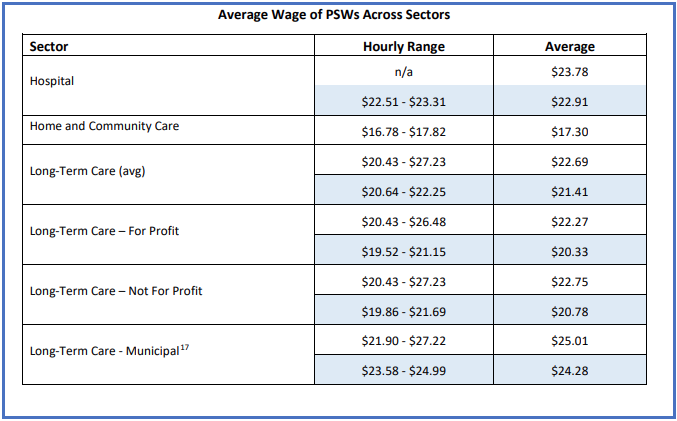
Average PSW Wages Across sectors in Ontario:
 (Source : Long-Term Care Staffing Study. Ontario.ca)
Hospital Information:
- White Data: Official reports from the Ontario Hospitals Association (OHA).
- Blue Data: Union agreements from the government’s database (MOL).
Long-Term Care Information:
- White Data: Staffing reports voluntarily given by the long-term care homes.
- Blue Data: Union agreements from the government’s database (MOL).
11. The Solution: Beyond the Pay Stub
While looking for the highest paying PSW jobs, it’s crucial to consider more than just the hourly rate.
Factors Influencing PSW Salary:
- Experience: More experience almost always means higher pay.
- Location: Urban areas (like Toronto) often have slightly higher rates than rural regions, though the demand for PSW in Canada is high everywhere.
- Employer: Private agencies, public health organizations, and unionized facilities can have different pay scales.
- Specialization: PSWs with additional training (e.g., palliative care, dementia care) may command higher wages.
- Overtime/Shift Premiums: These can significantly increase your take home pay, especially in Long Term Care.
Benefits: Beyond the Hourly Wage
Consider the total compensation package:
- Health Benefits: Do they offer medical, dental, vision?
- Pension Plans/RRSP Contributions: Crucial for long term financial security.
- Paid Time Off: Vacation, sick days, personal days.
- Professional Development: Opportunities for ongoing training and education.
“According to the Job Bank – Government of Canada² – The Kitchener – Waterloo – Barrie Region experienced a significant labour shortage for essential community roles, including Home Support Workers and Housekeepers, over the past three years (2022 to 2024). This period saw a persistent and acute talent gap where the demand for staff far outpaced the available workforce, leading to high vacancy rates. This challenge indicates a critical need for recruitment and retention strategies to ensure these key service sectors can meet the growing needs of the community.
“Projected job openings (2024-2033) BY Canadian Occupational Projection System (COPS)³
Over the period 2024-2033, a total of 26,200 job openings are projected, resulting from both job creation (expansion demand) and replacement demand (retirements, in-service deaths, or emigration). This equates to an average of 2,620 per year, representing approximately 3.9% of its 2023 employment level (67,400 workers).
12. Bridging the Training-to-Work Gap in Long-Term Care
Long-Term Care (LTC) organizations often report a significant gap between what healthcare workers learn in school and the realities of the job. While training teaches the ideal environment, the fast pace, high pressure, and increasing complexity of resident needs – made worse by staffing shortages – make the actual work far more demanding. This pressure forces Personal Support Workers (PSWs) to take on duties outside their scope of education and leaves little time for staff to pursue essential continuing education. Similarly, nursing programs may not sufficiently tailor education or placements to the specific needs of LTC, leaving new nurses unprepared for both the complex care and the required leadership and management demands. Recommendations, such as those from the Gillese Report, emphasize the need for improved education (including geriatric care and risk management) and more LTC-specific placements, along with better training in areas like cultural competency and basic geriatric medicine.
13. A1 Global College: Your Foundation for Success
No matter which path you choose – Long-Term Care, Retirement Home or Home Care – a solid educational foundation is paramount. At A1 Global College, our comprehensive PSW course in Waterloo is designed to equip you with the knowledge, practical skills, and compassionate approach needed to excel in any care setting.
A1 Global College program emphasizes more on:
- Hands on Training: Practical experience to build confidence.
- Experienced Instructors: Learn from professionals currently in the field.
- Industry Relevant Curriculum: Covering all essential aspects of PSW care, aligned with Ontario standards.
- Career Support: We help you navigate the job market for PSW jobs Kitchener Waterloo
Invest in your future with A1 Global College and prepare for the rewarding challenges of a PSW career!
Learn more about the A1 Global College PSW Program today!
UTM link – https://cutt.ly/Lte0Vq0J