

Course Overview
This 48-week diploma equips you for a career in Health Services Administration & Management. The program provides 840 instruction hours and 120 practical hours, preparing you for administrative, clinical scheduling, and electronic medical record tasks as a medical administrative assistant. It creates a strong foundation for leadership opportunities in healthcare management settings.
What You Will Learn
- HEALTHCARE SYSTEM OPERATIONS
- PROFESSIONAL ADMINISTRATIVE WRITING
- APPOINTMENT & FRONT DESK PROCEDURES
- MEDICAL TRANSCRIPTION & DICTATION
- PROVINCIAL BILLING & CODING
- ANATOMY & PHYSIOLOGY
- Program Type: Diploma
- Campus: Mississauga, Waterloo
- Start Dates:Coming Soon
- Program Mode: Online
- Financial Aid Available
Admission Requirements
- High School Diploma or equivalent
- Mature student (18 years or older)
- Proficiency in English language
- Wonderlic Scholastic Level Exam
Career Options
- Administrative Assistant - Medical
- Medical administrative assistant
- Medical Secretary
- Ward Secretary
- Ward Secretary - Hospital
- Medical Stenographer
- Caseload Planner – Home Health Care Services
Master healthcare delivery systems, administrative workflows, and organizational structures to lead efficient medical facilities.


Develop professional business writing, workplace etiquette, and team communication skills required for supervisory roles.
Direct office workflows using EMR software, medical transcription, and accurate provincial billing and coding.

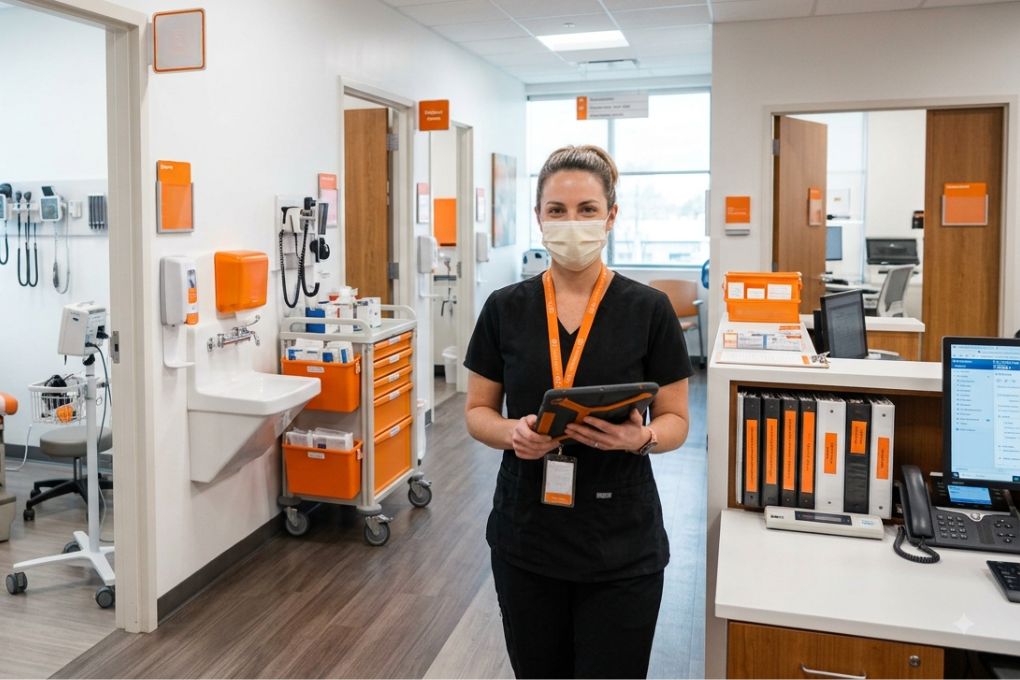
Oversee infection control protocols, diagnostic safety, and proper health record privacy to ensure smooth clinic operations.
program courses
During the course students will develop an understanding of the key issues and features present in the Canadian health care system. The course will begin with a general overview of the history and development of the different aspects that make up the Canadian health system, then go on to explore current and future issues facing the system.
The Canadian health system is complex, dynamic, and made up of many different components, with different funding mechanisms. Each sector is faced with its own issues and challenges. The continual evolution of health care in Canada is influenced and shaped by a vibrant public and political debate. Changing public expectations, increasing demand for services as our population ages, developments in biomedical technology and rising proportion of provincial government budget spent on health care present challenges and opportunities for improving the quality of services provided to the public.
This course introduces prefixes, suffixes, and word roots used in the language of medicine. Topics include medical vocabulary and the terms that relate to the anatomy, physiology, pathological conditions, and treatment of selected systems. Upon completion, students should be able to pronounce, spell, and define medical terms as related to selected body systems and their pathological disorders.
In this course, students will be introduced to Microsoft Office basics including how to use Word, Excel, PowerPoint, and Outlook. Various correspondence and business documents will be demonstrated using Microsoft Office software. Students will also learn how to use the internet to view various sources to find documents, sources, view correspondence, and view business related websites related to drafting of business documentation for the business office environment.
Effective communication is vital in the medical industry when interacting with patients, healthcare staff, and medical suppliers. This course prepares students for the workplace by establishing clear professional standards for both verbal and written communication. Students will explore the communication process, foundational communication theory, active listening techniques, and oral presentation skills. Particular emphasis is placed on navigating intercultural communication and overcoming barriers when interacting with diverse patient populations and global suppliers. Additional topics include small group dynamics, professional written correspondence (such as electronic medical records documentation and referral letters), and formal meeting procedures. By the end of the course, students will be able to effectively produce and communicate information using a variety of formats and technologies appropriate for a modern healthcare office environment.
This course introduces students to foundational concepts in human anatomy and physiology relevant to health services administration and medical office environments. Students will review major body systems, including the musculoskeletal, digestive, urinary, integumentary, reproductive, cardiovascular, respiratory, nervous, and endocrine systems. Common disorders and age-related changes will also be discussed to support students’ understanding of healthcare terminology, clinical documentation, patient records, scheduling, and professional communication in healthcare settings.
This course will prepare students with the basic knowledge needed in medical office administration and procedures, and professional conduct. Students will develop skills in appointment scheduling, reception and communication skills, filing, referrals, and pharmacology. Topics will include information regarding the inventory and supplies used in a medical office, patient rights, and the allied health professionals.
During the course students are introduced to the field of health information management. Content areas include an overview of the electronic patient record, professional roles within the field, professional organizations, the professional Code of Ethics; the content and structure of manual, computerized and hybrid health records and the standards that govern the development of the record within a health care facility; viewing medical documents and e-forms.
The principles and practices of infection control are critical to creating and maintaining a safe environment for patients, health care professionals, and visitors in an ambulatory care setting. Medical assistants who are in contact with patients and participate in medical and surgical procedures during their workday must observe infection control techniques to achieve medical and surgical asepsis. In this course students are presented with the underlying theories of infection control, including principles of immunity, classifications of infectious agents, and related means of transmission and symptoms. Students learn how to sanitize and disinfect the instruments and equipment frequently used in the ambulatory care setting. Quality control and maintenance procedures are stressed as being equally important aspects of maintaining proper infection control standards.
This course presents students with the clinical procedures and tests commonly performed in medical settings. Students will be taught relevant theory about clinical procedures. They will develop a beginning competency in selected clinical skills, and gain knowledge of the basic instruments, equipment, and supplies used in medical settings. This course will help students develop the skills to assist physicians and prepare patients for tests and examinations. They will practice setting up an examination room with the appropriate equipment and supplies for examinations.
This course will provide students with a working knowledge of transcription of medical reports. Transcription is taking the spoken word and turning it into a written document, therefore this course introduces students to the words and phrases of medical practice with the assistance of a software program. Medical terms that students previously studied will relate to those heard with the software. By the end of this course, students will have developed entry-level transcription skills for transcribing dictated materials in an accurate and complete manner, following the proper documentation requirements used in areas of the medical field.
This course introduces students to data entry for both manual and computer billing to the Medical Services Plan (MSP). Students will discover billing for visits, supplementary items, and diagnostic procedures carried out in a medical office, a hospital, or home. Students will learn how to accurately process claims and forms related to alternate billing, including requirements for WorkSafe, insurance providers, reciprocal procedures, and private companies. Emphasis is placed on the Preamble, Fee, and Diagnostic Code Schedule from MSP. Students will create a computerized medical clinic, register new doctors, new patients, and newborns. They will generate an electronic appointment schedule with appointment codes and computer reports through to the completion of accurate billing records.
This course prepares students with simple and powerful methods for successful career building. Students will be shown effective ways to design a professional resume and what pertinent information to include. Students will design job-posting-specific cover letters that complement their resumes and accentuate their skills and qualifications. Students will be introduced to the various methods in which they can apply for jobs (cold-calling, internet resources, and job banks) and how to effectively apply for jobs in numerous ways. Students will participate in a mock job interview assignment in which they will hone their interview skills and deportment. The key to a successful interview is being prepared. Resources will be available to students to assist them in finding a job in their chosen field.