Table of Contents
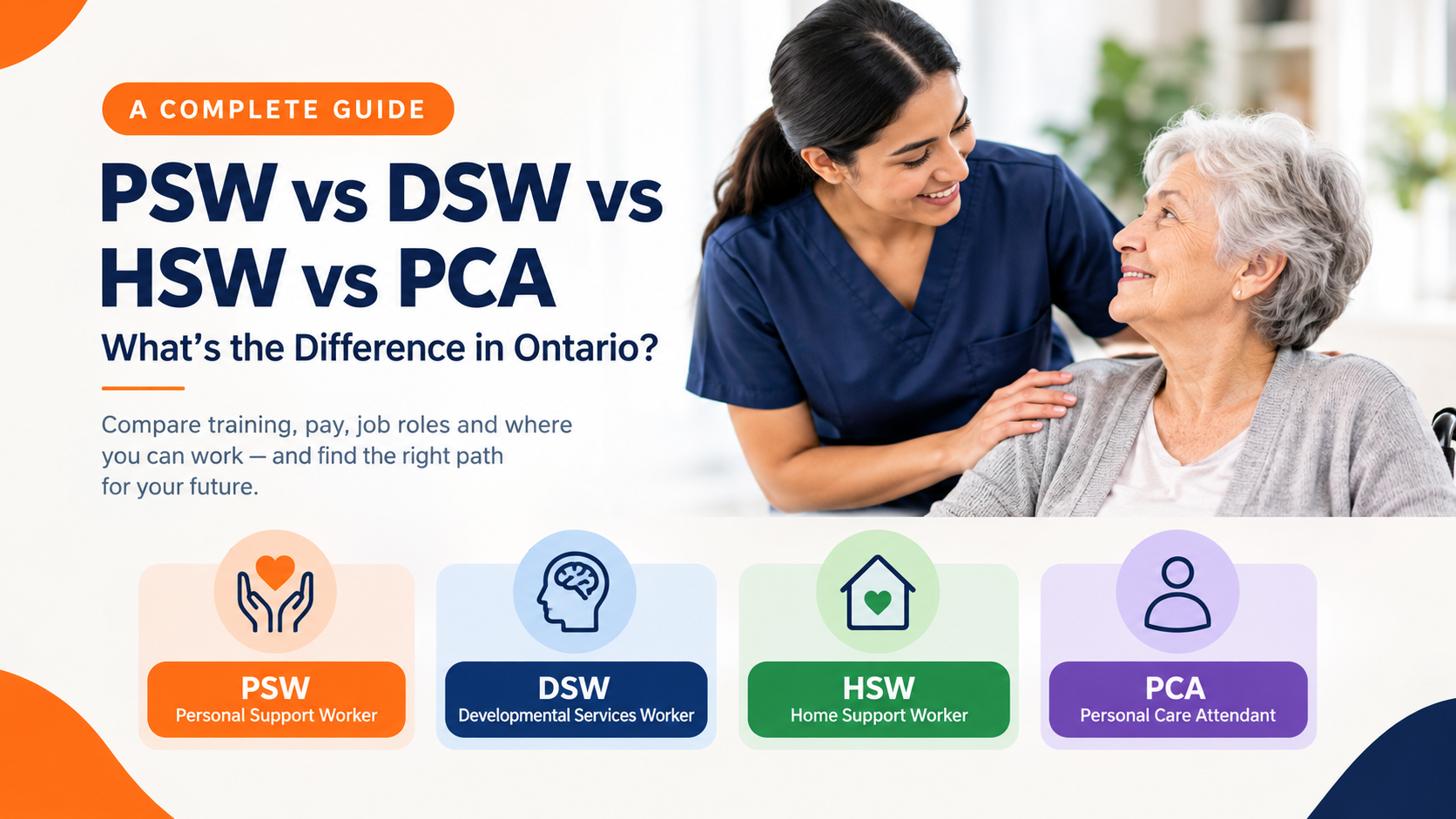
You open a job board and search “support worker.” One posting asks for a PSW. The next wants a DSW or HSW. A third is hiring a PCA and says “PSW or equivalent.” The shifts look similar. The titles do not.
That confusion can be expensive. A 26-week certificate and a two-year diploma are very different investments in time and money. Pick the wrong one and you may finish school only to find that the employer you wanted asks for something else.
This guide puts the four titles side by side. You will see what each one really means, how long it takes, and which one fits your situation. (Looking for the US title CNA? We cover that in CNA vs PSW in Ontario.)
“NOTE: PSW is the main care credential in Ontario and the one long-term care homes look for. DSW is a longer college diploma focused on supporting people with developmental disabilities. HSW is mostly a home-care title. PCA is a job title, not a certificate. Many employers accept more than one, so always read the posting.”
1. Credential or job title? The idea that clears up the confusion
A credential is what a school gives you: a PSW certificate or a DSW diploma. A job title is what an employer calls the role. Some names are both. Some are only one.
- PSW and DSW are credentials that are also used as job titles.
- HSW and PCA are mostly job titles used by home-care and supportive-living employers.
Job Bank, the federal job site, groups “personal care attendant – home care” and “home support worker” with PSW home support under one occupation (NOC 44101). That tells you the day-to-day work overlaps a lot. What changes is the paperwork an employer wants to see.
2. PSW vs DSW vs HSW vs PCA: side-by-side comparison
| PSW | DSW | HSW | PCA | |
| What it is | Credential and job title | Credential (college diploma) and job title | Mostly a job title; some schools offer an HSW certificate | Job title only |
| Typical training | PSW certificate at A1 Global College: 26 weeks (400 theory + 300 practical hours). Public colleges: about 8 months to 1 year | 2-year Ontario College diploma (4 semesters). Apprenticeship route for people already working in the field | Short home-support certificate, or PSW. Varies by employer | No set training. Employers usually ask for a PSW or HCA certificate |
| Main focus | Personal care and daily living for seniors and people with illness or disability | Building skills, independence and inclusion for people with developmental disabilities | Personal care plus light housekeeping in clients’ homes | Personal care and light support, often in home care or retirement living |
| Where you work | Long-term care homes, home care, hospitals, retirement residences | Group homes, community living agencies, day programs, schools | Clients’ homes, retirement residences | Home care, supportive housing, retirement living |
| Long-term care homes | Yes, with a recognized PSW credential | Confirm with the home; rules require PSW qualifications, with limited exceptions | May not qualify on its own | May not qualify on its own |
| Typical pay, Kitchener-Waterloo-Barrie (median per hour) | $20.00 (range 17.20–26.00) | $24.09 (range 17.20–35.00) | $20.00 (same Job Bank group as PSW home support) | $20.00 (same Job Bank group as PSW home support) |
| Job outlook, Ontario 2025–2027 | Good | Moderate | Good | Good |
| Best for | The fastest start and the most employer options | A long-term career in disability support | A home-care focus | Not a path on its own: check what the posting requires |
Pay data comes from Job Bank (PSW home support: updated December 2024; DSW: the latest regional figures we could confirm, updated November 2023). Wages change, so check Job Bank before you decide.
3. What the table doesn’t tell you
a) PSW: the credential most doors accept
Two things make PSW the common denominator. Ontario’s long-term care rules require homes to hire PSW-qualified staff, regardless of the job title they use, with limited exceptions, and the province’s long-term care careers page lists a PSW program certificate as the requirement. And home-care postings for PCA and HSW roles often list PSW as an accepted credential.
For a look at a typical shift, read our guide to PSW duties and responsibilities. To see who is hiring, see PSW agencies in Ontario.
b) DSW: support and skill-building, not just personal care
PSW work centres on care: bathing, dressing, mobility and meals. DSW work centres on helping a person with an intellectual or developmental disability build skills, make choices and take part in the community.
DSW is also a voluntary skilled trade in Ontario, so people already working in the field can train through an apprenticeship. Pay is higher on average, but so is the time you spend studying. We put numbers on that trade-off in Section 4.
c) HSW: a home-care label with a narrower reach
HSW usually means a worker in a client’s home who provides personal care and light housekeeping. Some schools offer a short HSW certificate, and many home-care employers accept it.
The catch is reach. A certificate built around home care may not meet the PSW qualification rules for long-term care homes. If you start as an HSW, plan the upgrade. Some employers run combined programs.
d) PCA: read the posting, not the title
Ontario’s published college program standard is for PSW programs. PCA, short for personal care assistant or attendant, is a title employers use. Before you apply to a PCA posting, ask three questions:
- Which credential do you require?
- Who are the clients: seniors, children or adults with disabilities?
- What training do you provide? Some disability-support postings also ask for Safe Management Training, first aid and CPR.
4. Which one should you choose?
| If you… | Start with | Why |
| Want to be working in about six months | PSW | A 26-week program versus a two-year diploma |
| Want to work in a long-term care home | PSW | Homes must hire PSW-qualified staff, with limited exceptions |
| Want a long-term career supporting adults with developmental disabilities, or want to be an educational assistant | DSW | The diploma is built for that work |
| Want to become a nurse later | PSW | It leads into the PSW to RPN bridging pathway |
| Are drawn to counselling, case management or crisis work | Community Services Worker | See Section 5 |
| Are already working as an HSW or PCA with no certificate | PSW | It makes your experience count with more employers |
4.1 What the extra study time is worth: an illustration
Say a PSW earns $20.00 an hour and a DSW earns $24.09, both working 30 hours a week for 52 weeks.
- PSW: about $31,200 a year
- DSW: about $37,580 a year, a gap of roughly $6,380
- A two-year DSW diploma takes 78 weeks longer than a 26-week PSW certificate. At $20.00 and 30 hours a week, that head start is worth about $46,800 in earnings.
On these assumptions, the DSW pay premium takes roughly seven years to make up the head start. This ignores tuition, raises, overtime and benefits, so treat it as a way to think, not a prediction. If you love disability support work, the diploma can still be the right choice. If you mainly want a fast, stable start, PSW is hard to beat.
“Ready to start your PSW training? A1 Global College offers a NACC-approved, 26-week PSW certificate with a hybrid format and multiple start dates at the Waterloo, Mississauga, Scarborough and Hamilton campuses. Review the Personal Support Worker program and see your financial aid options, including OSAP. Curious about funding for high-demand careers? Read our Better Jobs Ontario guide.”
5. Where the Community Services Worker program fits
If the DSW side of this comparison appeals to you, look at the Community Services Worker (CSW) path as well. A1 Global College CSW program is a 44-week diploma with 775 theory hours and 105 practical hours. It is delivered online at the Mississauga and Waterloo campuses and covers case management, crisis intervention, mental health foundations and documentation.
A1 Global College lists Developmental Services Worker among the possible careers, alongside mental health worker, addictions worker and youth and family support worker. One honest note: a CSW diploma and an Ontario college DSW diploma are different credentials. Some employers ask for the DSW diploma by name, so check the posting.
Job Bank reports a median of $26.56 an hour in the Kitchener-Waterloo-Barrie region for community and social service workers (the occupation group that includes DSWs), updated November 2025. Learn more in our guide to becoming a Community Services Worker, or review the Community Services Worker program.
6. Frequently asked questions
a) Can I work in a long-term care home with a DSW diploma?
Not automatically. Ontario’s long-term care regulations require staff hired as PSWs, or to provide personal support services, to hold PSW qualifications, with limited exceptions. Ask the home whether your credential qualifies before you apply.
b) Can a PSW work in disability services?
Often, yes. Postings in the Waterloo area have been titled “Personal Support Worker/Developmental Service Worker.” Employers set their own rules, and some ask for the DSW diploma specifically.
c) Can a PSW become a DSW without starting over?
Partly, in some cases. Georgian College says graduates of its Personal Support Worker program may be eligible for advanced standing in its DSW program. Policies differ by college, so ask the admissions office.
d) Where do CNA and HCA fit?
CNA is a US title, and HCA is used in provinces such as Alberta. Neither is the standard Ontario term. Our CNA vs PSW guide explains how they map to the PSW role.
7. Not sure which path fits you?
Titles are confusing, but your next step does not have to be. If you want to start working soon, a PSW certificate is the clearest route. If you are weighing it against a longer diploma, talk it through first. Book a virtual consultation to explore your options with A1 Global College.

Disclaimer: This article is for general information only and does not guarantee employment or pay. Check each employer’s requirements and the latest Job Bank data before you decide.